
Malawi Cichlids Fish
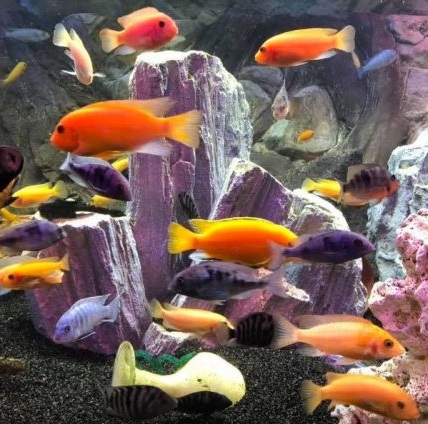
Lake Malawi is noted for being the site of evolutionary radiations among several groups of animals, most notably cichlid fish. There are at least 700 cichlid species in Lake Malawi, with some estimating that the actual figure is as high as 1,000 species. The actual number is labelled with some uncertainty because of the many undescribed species and the extreme variation among some species, making the task of delimiting them very complex. Except for four species (Astatotilapia calliptera, Coptodon rendalli, Oreochromis shiranus and Serranochromis robustus), all cichlids in the lake are endemic to the Malawi system, which also includes nearby smaller Lake Malombe and the upper Shire River. Many of these have become popular among aquarium owners due to their bright colors. Recreating a Lake Malawi biotope to host cichlids became quite popular in the aquarium hobby. Most Malawi cichlids are found in relatively shallow coastal waters, but Diplotaxodon has been recorded down to depths of 200–220 m (660–720 ft) and several (especially Diplotaxodon, Rhamphochromis and Copadichromis quadrimaculatus) are known from pelagic waters.
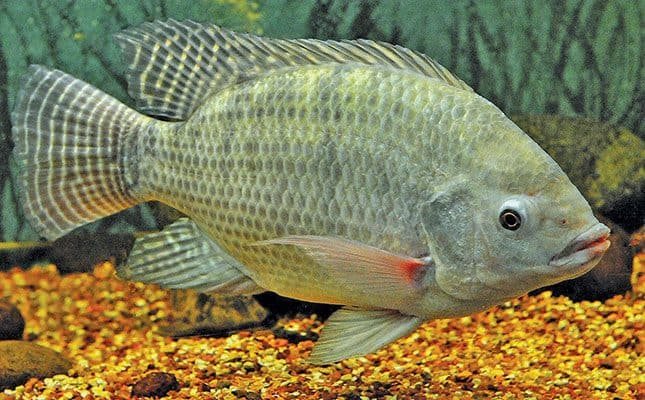
The second group, the tilapia, comprises only six species in two genera in Lake Malawi: The redbreast tilapia (Coptodon rendalli), a widespread African species, is the only substrate-spawning cichlid in the lake. This large cichlid mainly feeds on macrophytes. The remaining are five mouthbrooding species of Oreochromis; four chambo in the subgenus Nyasalapia (O. karongae, O. lidole, O. saka and O. squamipinnis) that are endemic to the Lake Malawi system, as well as the closely related O. shiranus, which also is found in Lake Chilwa. The Malawi Oreochromis mainly feed on phytoplankton, reach lengths up to 26–42 cm (10–17 in) depending on the exact species, and are mostly black or silvery-gray with relatively indistinct dark bars. Male chambo have unique genital tassels when breeding, which aid in egg fertilisation in a manner comparable to the egg-spots on the anal fin of haplochromines.
Malawi Non-Cichlids Fish
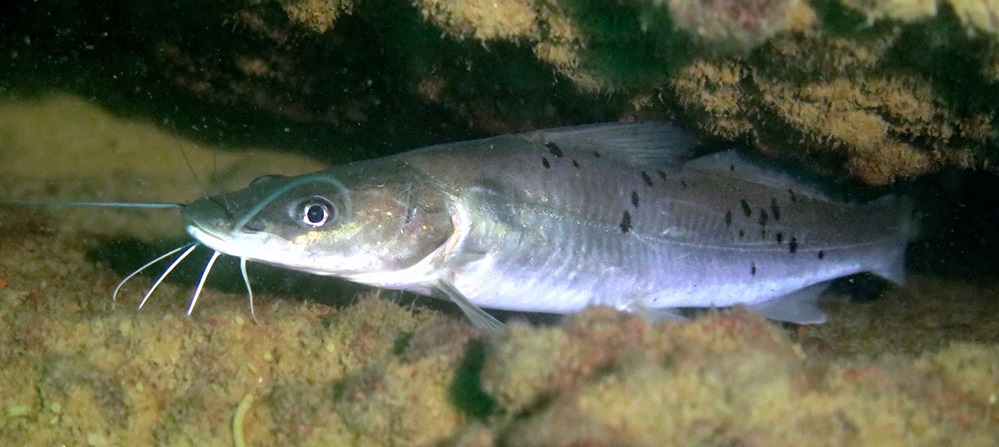
The kampango (Bagrus meridionalis), one of the largest catfish, reaching up to 1.5 m (4.9 ft) in length.
The vast majority of the fish species in the lake are cichlids. Among the non-cichlid native fish are several species of cyprinids (in genera Barbus, Labeo and Opsaridium, and the Lake Malawi sardine Engraulicypris sardella), airbreathing catfish (Bathyclarias and Clarias, and the kampango Bagrus meridionalis), mochokid catfish (Chiloglanis and Malawi squeaker Synodontis njassae), Mastacembelus spiny eel, mormyrids (Marcusenius, Mormyrops and Petrocephalus), the African tetra Brycinus imberi, the poeciliid Aplocheilichthys johnstoni, the spotted killifish (Nothobranchius orthonotus), and the mottled eel (Anguilla nebulosa).
At a genus level, most of these are widespread in Africa, but Bathyclarias is entirely restricted to the lake.